Key takeaways
- The Bridging the Future summer school runs for eight days across two weeks in August at the UCL Department of Physics & Astronomy, 10:00 to 16:30, with English for Science every morning and practical science every afternoon.
- It is free to every student: travel across TfL Zones 1–6, lunch and all materials are covered for 30 places a year, and in 2025 315 young people applied for those places.
- Summer School 2026 has finished; dates, the deadline and the application forms for Summer School 2027 will be announced on the Apply to our programme page.
- TASO rates the evidence on university summer schools as emerging, with a small positive impact on aspirations and attitudes but more evidence needed on whether they change progression to higher education.
- University of Oxford research funded by the Bell Foundation found that proficiency in English explains 22% of the variation in EAL pupils’ achievement, against a typical 3–4% explained by gender, free school meal status and ethnicity.
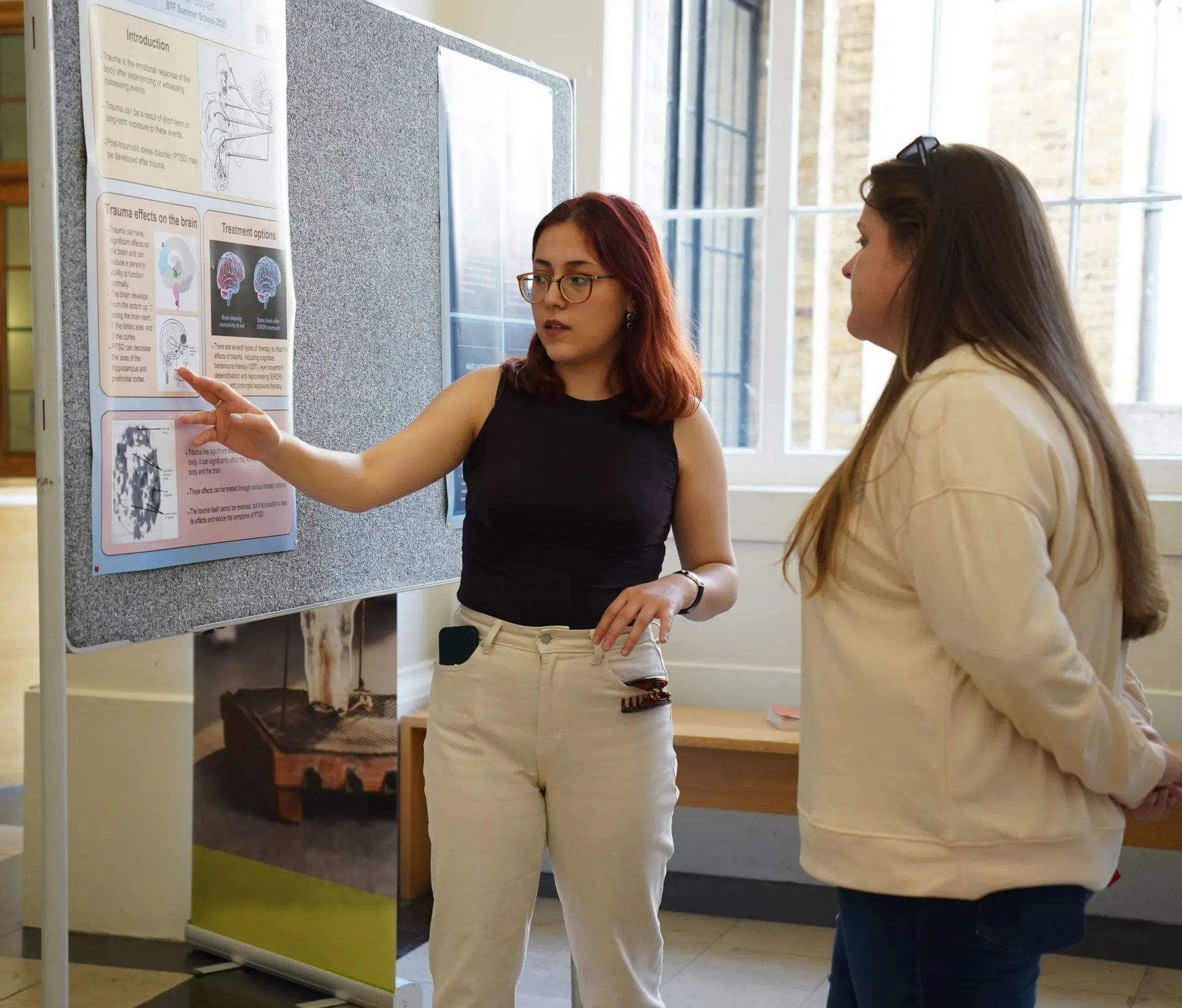
Our free STEM summer school is eight days spread over two weeks in August at University College London. Each day runs from 10:00 to 16:30: English for Science in small, level-set groups every morning, hands-on physics, chemistry, biology or coding every afternoon, and on the last afternoon, students present academic posters to academics in UCL’s North Cloisters. Travel, lunch and materials are covered, so it costs a student nothing.
Most descriptions of an outreach programme are written for funders. They describe aims, outcomes and impact, in that order, and they leave out the thing a sixteen-year-old actually wants to know, which is: what will the first morning be like, and will I be the only one who doesn’t understand?
This article is the other kind of description. It sets out how the fortnight works — the days, the rooms, the timetable, the equipment, the money — for anyone deciding whether to apply for a future summer school, whether to volunteer, whether to fund it, or whether to build one of their own. It also sets out, as honestly as we can, what independent research says about whether university summer schools make a difference, and why we designed ours the way we did.
- Two weeks in August, Monday to Thursday
- 8 daysTwo weeks in August, Monday to Thursday10:00 to 16:30, at the UCL Department of Physics & Astronomy
- Places each year
- 30Places each yearIn 2025 we received 315 applications for them
- Cost to any student
- £0Cost to any studentTravel across TfL Zones 1–6, lunch and all materials are covered
Where the summer school came from
The programme did not start as a refugee project. Since 2016, a group of students and academics at UCL had been running summer schools that gave pupils from London state schools a chance to see the research happening at the London Centre for Nanotechnology — a multidisciplinary institute run jointly by King’s College London, UCL and Imperial College London — and in the UCL Department of Physics & Astronomy.
It opened up to recently arrived young forced migrants, refugees and asylum seekers because the organisers kept meeting the same problem: a cohort of young people who, in their own words, were lost in the GCSE vacuum because of their lower English level. We have written about that gap at length in The GCSE vacuum. By 2019 the course ran for two full weeks.
Everything since has been an attempt to make that fortnight work harder.
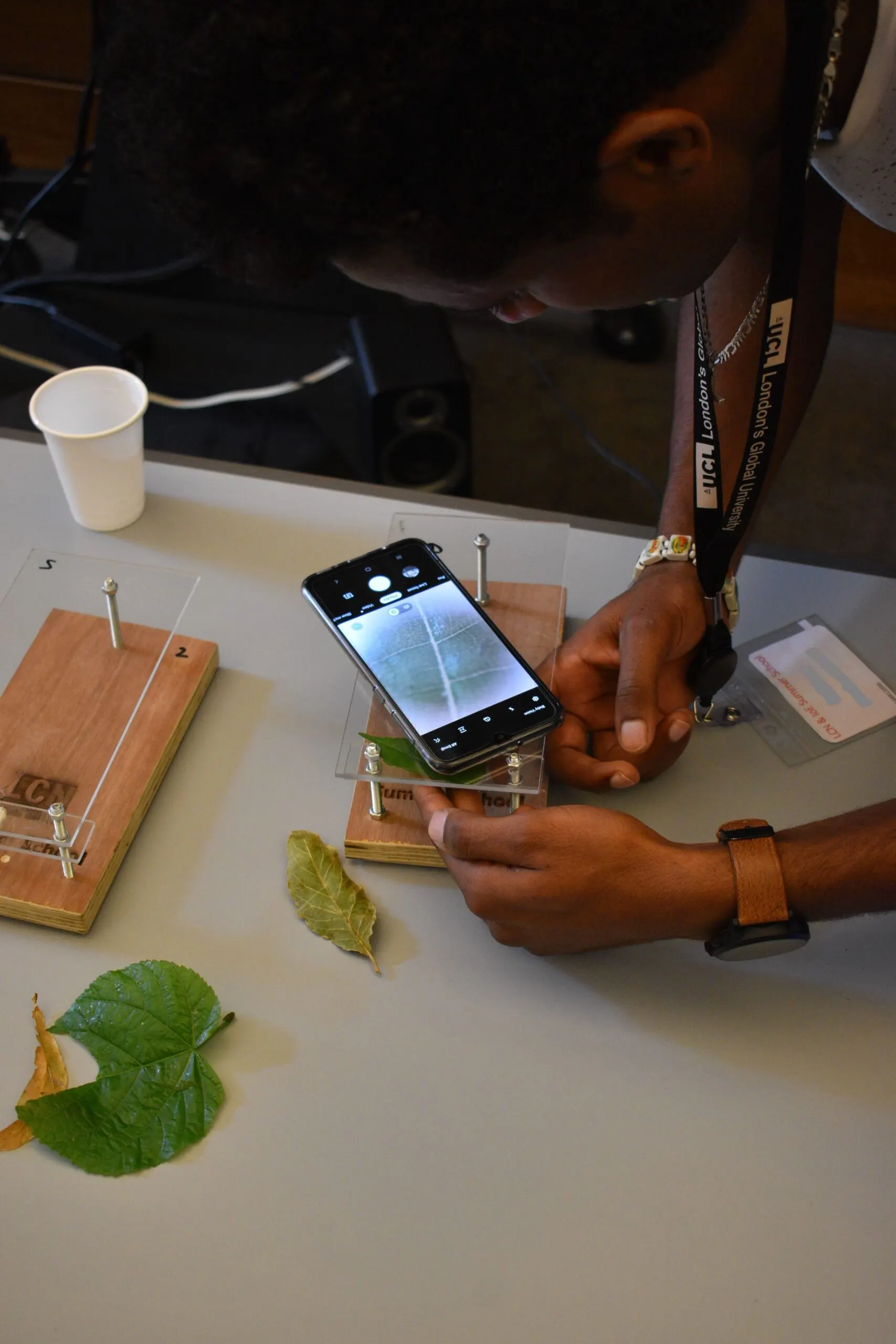
What does a day at the summer school look like?
Every day runs 10:00 to 16:30. That start time is deliberate. Students travel in from across Greater London — some from the outer zones — and a 09:00 start would mean leaving home at the busy end of the rush hour, on a journey that would otherwise come out of a budget that does not stretch.
The day splits cleanly in two.
| Time | What happens | Why it is there |
|---|---|---|
| 10:00–10:20 | Arrival, registration, breakfast items | A soft start; nobody is late on their first day in an unfamiliar building |
| 10:20–12:30 | English for Science, in small groups set by level | Writing, speaking, listening and reading, with the vocabulary the afternoon will use |
| 12:30–13:15 | Lunch, provided | Eating together is not a break from the programme; it is where the cohort forms |
| 13:15–16:00 | Practical workshop — physics, chemistry, biology, or IT and coding | Hands on equipment, in groups, with a demonstrator per group |
| 16:00–16:30 | Wrap-up, questions, tomorrow’s plan | Time for the questions nobody asks in front of the room |
Splitting the day is the single most important design decision in the programme, and it is the one most often got wrong elsewhere. The temptation is to fold language teaching into the science: teach the experiment, and let the vocabulary come along for the ride. It does not work. A student asked to acquire the passive voice and the concept of activation energy in the same forty minutes acquires neither.
Day one, in detail
The first morning does more work than any other, and it is almost entirely about lowering the stakes.
Students arrive between 10:00 and 10:20. There is food on a table. Nobody is asked to introduce themselves to the room, because standing up and saying your name in a second language, to thirty strangers, on your first morning, is a needlessly hard thing to ask of someone who may already be nervous about whether they belong in the building.
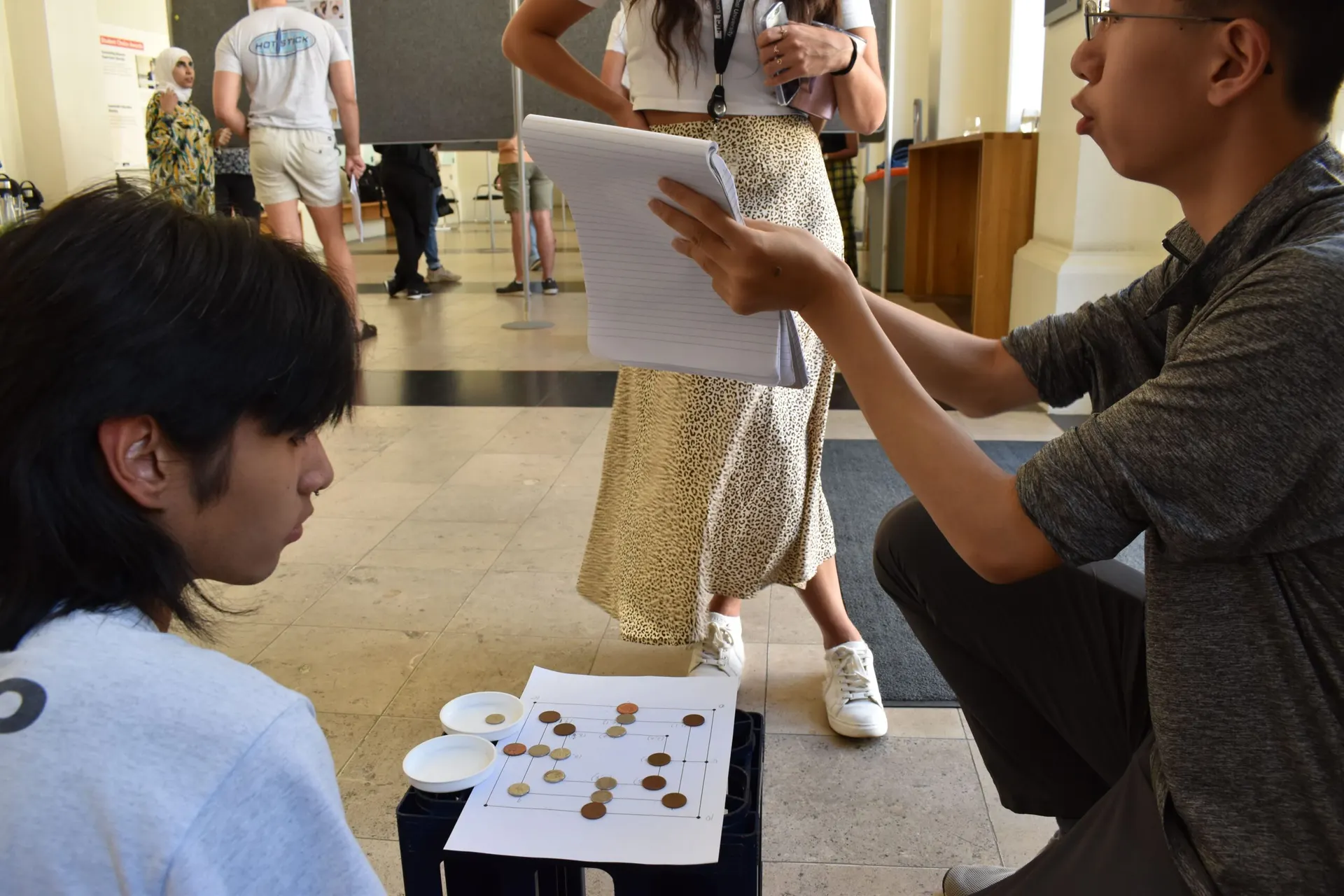
Instead the group is split immediately into small tables with a volunteer on each. The first activity is deliberately low-stakes and non-academic. By the time the English assessment happens — a short piece of writing and a conversation, used only to set the morning groups — the students have already spoken to three or four people.
The first afternoon is a practical, not a lecture. Something visual, something that works, something where nobody in the room has an advantage from having been in a British school. Extracting DNA from a strawberry is the perennial choice for a reason: it takes forty minutes, it produces a visible result, and it does not care what your English is like.
Nothing on day one is assessed in a way that carries consequences, and nothing requires a student to display a gap in front of the group. The English assessment is used for grouping and is described as such. That framing is not softness — it is the condition under which people are willing to try. Some of the young people who come to us have lived through disrupted schooling, loss or long periods of uncertainty, and a predictable, low-pressure start is part of what we mean by a safe environment. Our article on trauma-informed teaching for refugee students sets out the principles behind that in more depth.
Why is English taught on its own every morning?
Groups are small and assigned by level following the short assessment on day one. An English teacher works on writing, speaking, listening and reading — but with content drawn from the science the students will meet after lunch.
The gap this closes is specific. Conversational English and scientific English are different registers. Scientific English is dense with nouns that are also verbs, with hedged claims, with words that carry a technical meaning wholly different from their everyday one. Solution. Precipitate. Yield. Displacement. Significant. A student can be fluent enough to argue with a friend and still unable to parse an exam question.
By the end of the fortnight the morning work has fed into an academic poster, which is the last afternoon’s centrepiece.
What the research on academic English says
Two bodies of evidence shaped the mornings.
The first is about how much English proficiency matters. A five-year research programme by the University of Oxford, funded by the Bell Foundation and Unbound Philanthropy, looked at pupils in England who use English as an additional language. Its final report, summarised by the Bell Foundation in March 2021, found that proficiency in English explains 22% of the variation in those pupils’ achievement — compared with the typical 3–4% that can be explained statistically using gender, free school meal status and ethnicity.
The same research found that, for two-thirds of pupils who are new to English when they start Reception, it takes more than six years to reach the highest levels of proficiency, and that pupils who join later progress at the same rate. The implication the researchers drew is stark for anyone working with teenagers: a young person who arrives new to English, at any age, may need at least six years of support before they reach the level at which they can fully access the curriculum. A sixteen-year-old does not have six years before the next gate closes.
That research also found that judgements of proficiency are strongly influenced by the person making the assessment. It is one of the reasons our day-one assessment is used only to form groups, and is never used to decide who belongs.
The second body of evidence is about which English matters. The Education Endowment Foundation’s guidance report Improving Literacy in Secondary Schools, first published in 2018, argues for what it calls disciplinary literacy: the recognition that literacy is both general and subject-specific, and that reading, writing, speaking and listening are at the heart of knowing and doing science. In other words, the language of science has to be taught as language, deliberately, not absorbed by accident.
Put together, those two findings describe exactly the student we see. Many are in general ESOL classes at college, which teach the English of shops, forms and conversations — valuable, and necessary, and not the English of a chemistry practical. If you are supporting a young person through that stage, our guide to ESOL for 16–19 year olds explains how college provision is organised. The summer school mornings sit alongside that provision and add the one register it rarely reaches.
What happens in the afternoon labs?
Afternoons rotate through the disciplines. The activities change year to year with the volunteers available, but the spine has been stable.
Biology. Extracting DNA from fruit — a genuinely startling demonstration, because the DNA is visible, in the tube, in quantity, from a strawberry someone brought in. Microscopy, where students prepare their own slides and compete to capture the best image. One of our students won that competition and still talks about it.
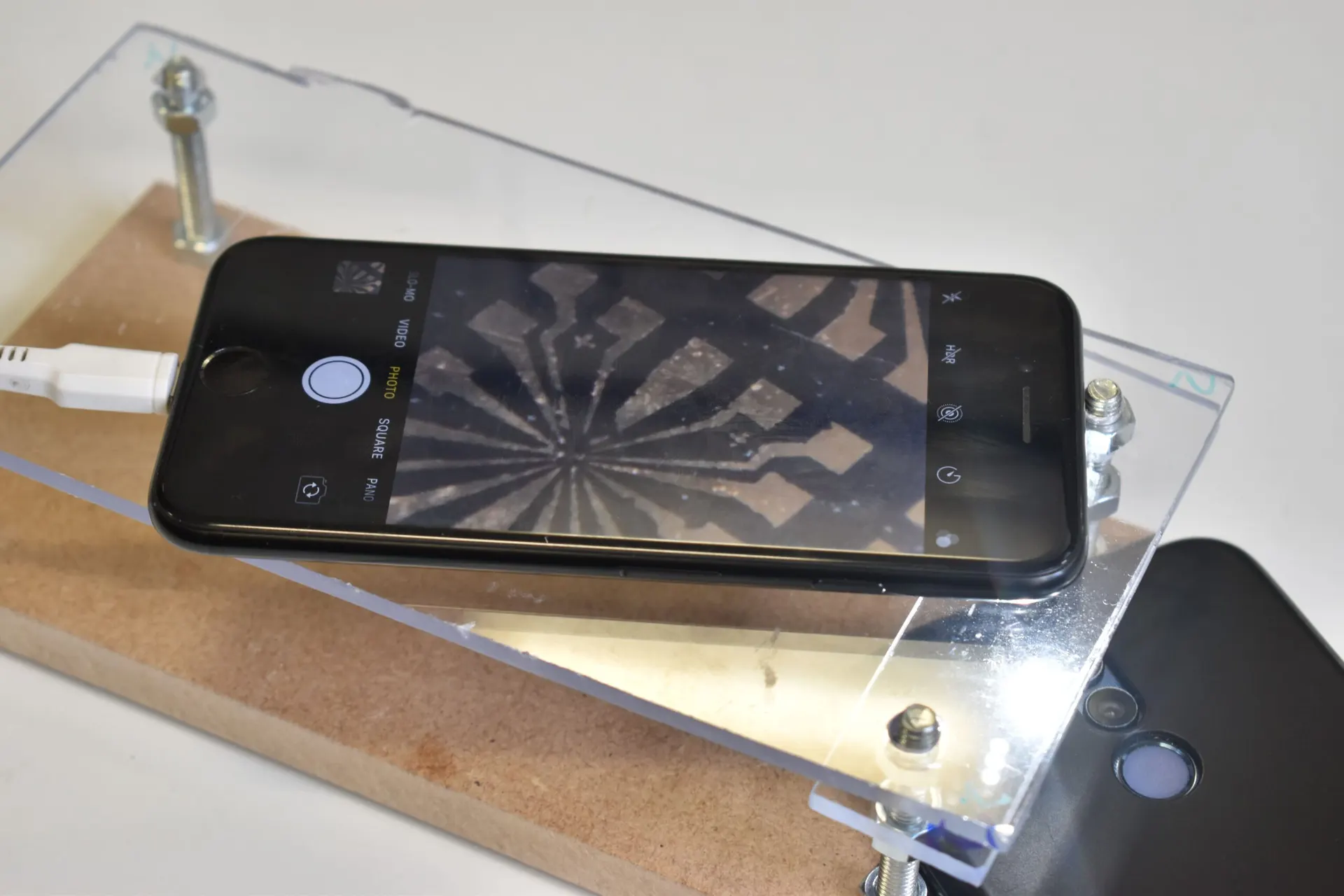
Physics. Building a working microscope from components. Optics, lasers, and demonstrations pulled straight from the department’s own outreach kit.
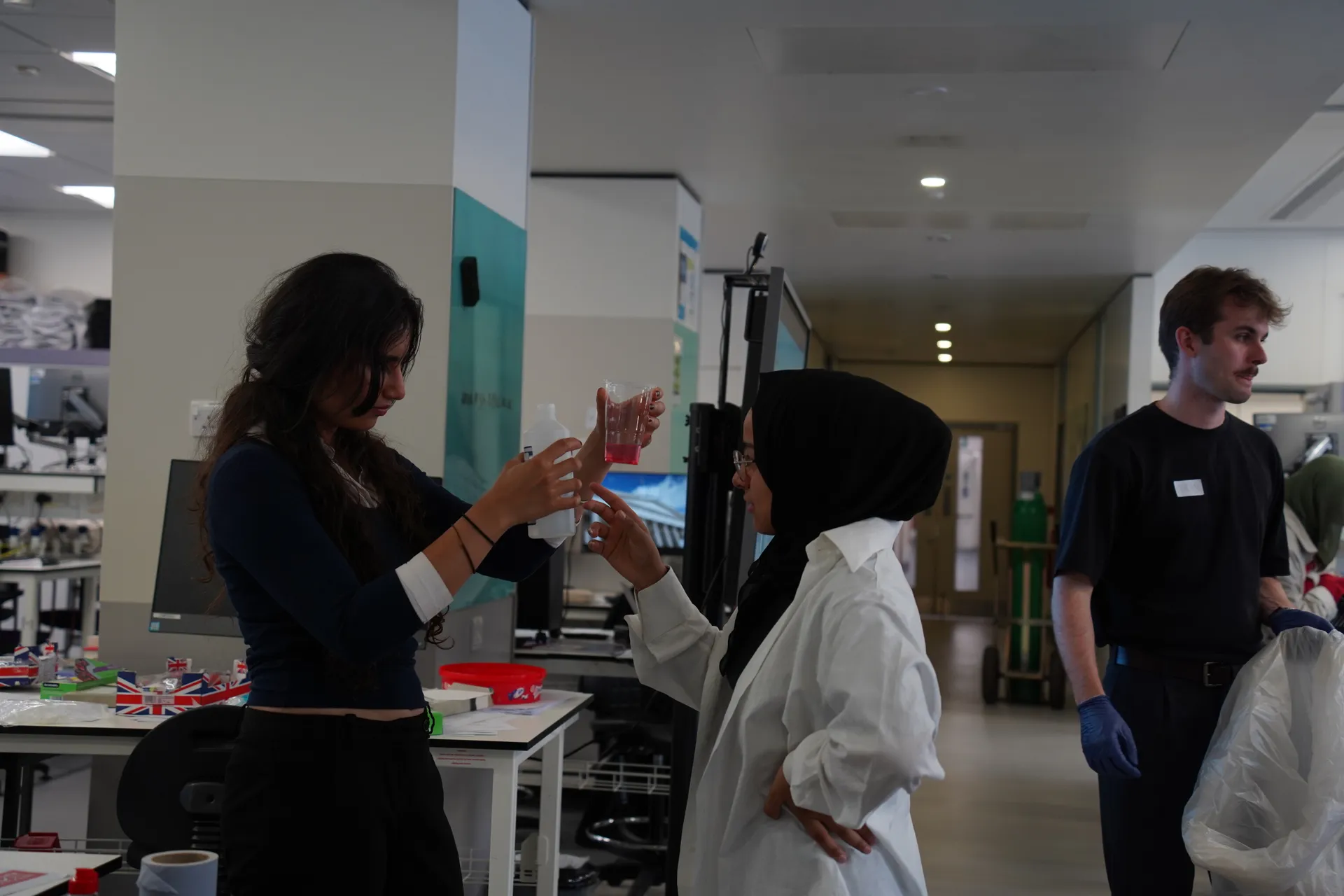
Chemistry. Reaction rates, indicators, the everyday chemistry that GCSE covers and that a student who joined the system at sixteen has never been taught.
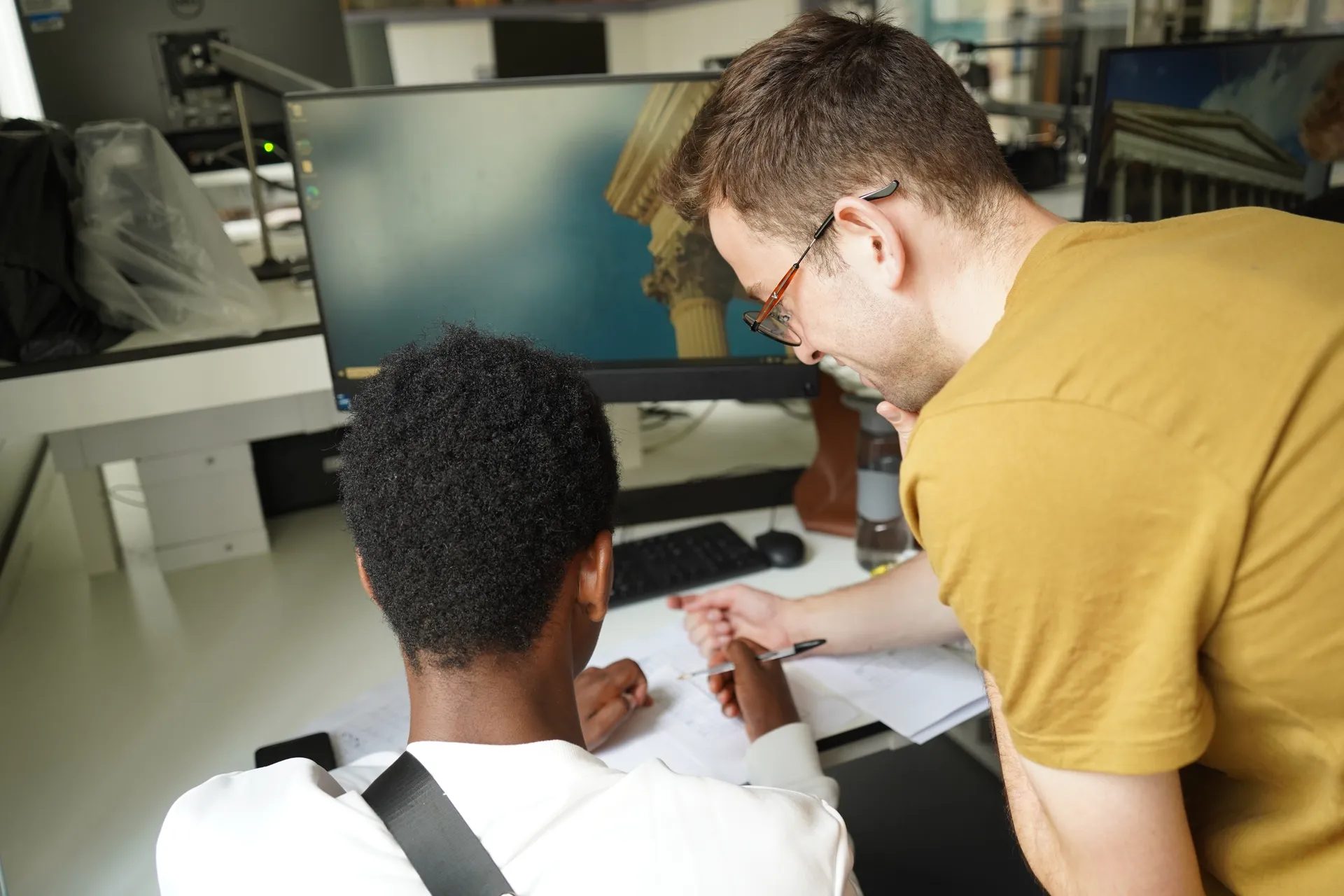
IT and coding. Programming and controlling a friendly programmable robot. Also, and less glamorously but just as usefully: Word, Excel and PowerPoint, creating an email address, and building a CV. Several of our students had never had an email address of their own before the summer school — a small example of a much wider problem we describe in digital exclusion and asylum seekers’ education.
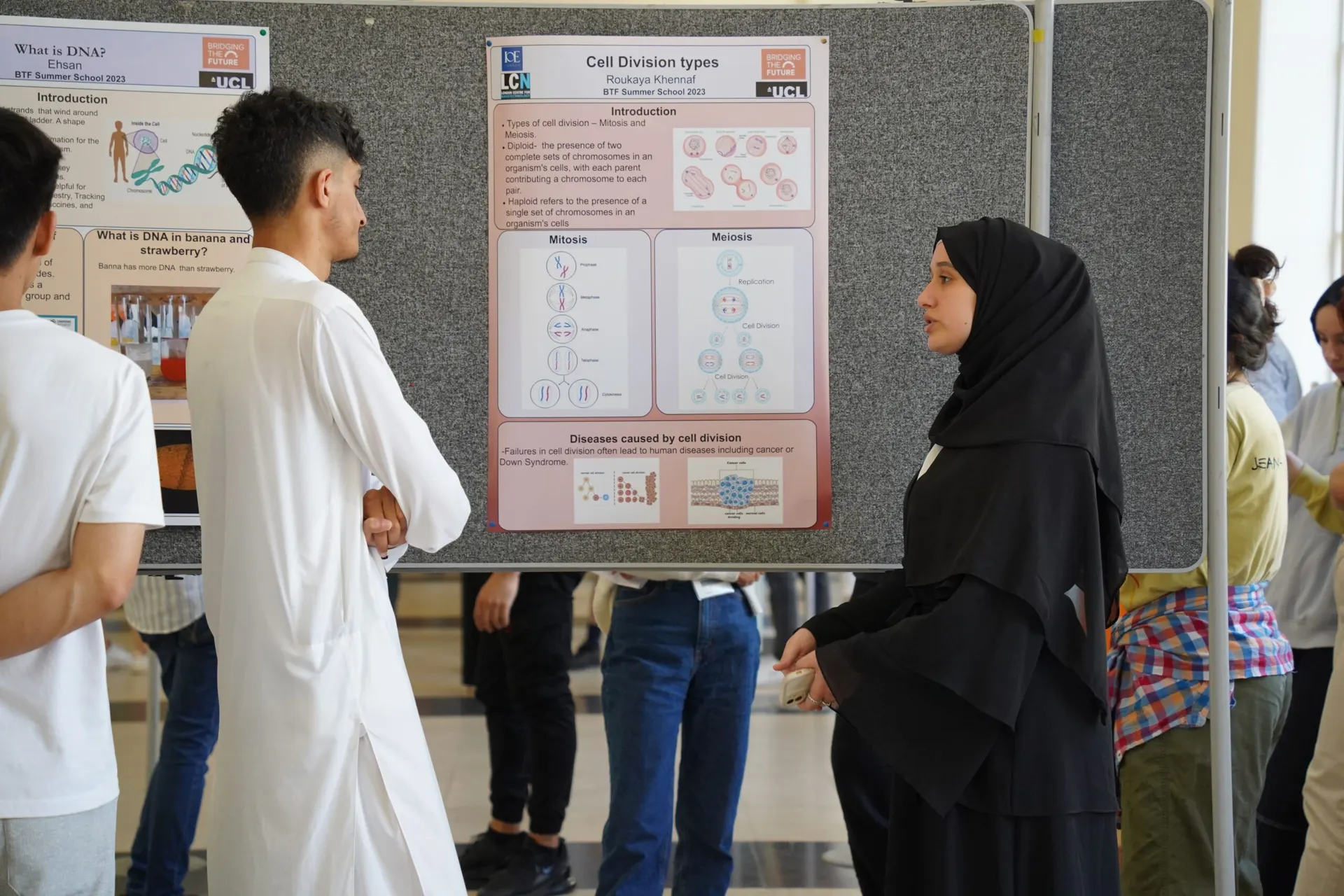
The equipment matters more than it sounds. These are real teaching labs in a real physics department, and the students are trusted with the kit. A young person who has spent a year being processed — assessed, placed, interviewed, moved — is handed a pipette and told to get on with it. The signal that sends is not subtle, and it is the point.
Why real labs matter: science capital
There is a research framework for that signal. The ASPIRES projects, begun at King’s College London under Professor Louise Archer and based at the UCL Institute of Education since 2017, followed young people’s science and career aspirations from age 10 to 19 through more than 40,000 surveys and 660 interviews. The ASPIRES 2 report was published in 2020.
Its findings cut against a common assumption behind science outreach. Young people generally liked science and valued scientists. Yet only around 16% aspired to become a scientist, a proportion that stayed stable from age 10 to 18. Across all five surveys, around 80% agreed that scientists are “brainy” — and students who did not see themselves, or were not seen by others, as clever were less likely to identify with science.
The researchers’ explanation is science capital: the science-related interests, attitudes, resources, behaviours and social contacts a person has. Their Year 13 analysis found that a student with high science capital was roughly six times more likely to pursue a physics degree, and two and a half times more likely to aspire to an engineering degree, than peers with medium or low science capital. Their recommendation was to focus on building science capital, rather than only on inspiring and informing young people about STEM.
ASPIRES did not study refugee students specifically, and we would not stretch its findings further than they go. But the concept fits what the afternoons are built to do. Meeting researchers who work in the department, handling equipment in a working department, and being treated as someone who can do science are all forms of science capital that a young person cannot easily acquire in the first year after arriving in a new country. Some of our students studied science seriously before they arrived; what is missing is rarely interest. It is the contacts, the vocabulary and the recognition. We explore why that matters for the long term in why STEM matters for young refugees.
Why does the last afternoon matter so much?
The fortnight ends with poster presentations in UCL’s North Cloisters. Each student chooses a subject, prepares an academic poster over the second week, and stands next to it while academics, students and passers-by ask them about it.
One of our students described what that was like:
My favourite part was the last project where we prepared academic posters of our chosen subject. As we were presenting them in the North Cloisters, many academics and students were interested and it was a good experience to explain a topic to an academic in that field, because I could also learn more from them. A summer school student, 2022 cohort
Another, who had arrived believing science was not for them:
My memorable experience from summer school was my presentation on the last day about colour blindness, before our certificates were given. This presentation was successful because I got a prize for my hard work. This seems unbelievable, but that presentation I did was the first time in my life standing in front of people explaining a topic I had never heard of before. This experience built my confidence. Enkophazion, summer school student
Enkophazion now wants to work in science.
We keep the poster session because it does something no lesson does. It converts a fortnight of being taught into forty minutes of being the expert — in a university building, in front of academics, in English. Everything before it is preparation for that inversion. In the language of the ASPIRES research, it is recognition: other people, in a scientific setting, treating the student as someone who knows something.
What the participants said
We keep the feedback because it is the most direct account we have of what the fortnight meant to the people who took part.
Dear UCL Summer School team, I would like to say a big thank you for every person in the Summer School team who have supported, taught, helped and encouraged us through these two weeks. I appreciate every single person and their effort in the team, I love the way you support the students and help them. I wish a very bright future for everyone. I will not have this opportunity again and it will always remain in my heart as a beautiful memory with you all. Student, 2019 cohort
My favourite part of the summer school was when we extracted DNA! Student, 2019 cohort
And from outside the programme:
I was so pleased to attend the celebration event. It was a great opportunity for the students to show what they had learnt in English and IT skills and it was a real pleasure to talk to them. It’s fantastic to see an Ogden alumnus supporting other young people to succeed. Clare Harvey, Chief Executive, The Ogden Trust
Do summer schools actually work?
It is a fair question, and the honest answer is more careful than most outreach material allows. We think anyone running, funding or referring a young person to a summer school should know what the evidence does and does not show.
What TASO’s evidence toolkit says
The most useful single summary is the evidence toolkit from TASO (Transforming Access and Student Outcomes in Higher Education), which reviews and commissions research on widening participation for the higher education sector. Its summer schools page rates the strength of evidence as emerging, the impact on aspirations and attitudes as a small positive impact, the impact on behaviour and outcomes as more evidence needed, and the cost as high.
TASO says plainly that there is not yet enough evidence to call summer schools an effective tool for widening participation or supporting progression. Students leave more confident than they arrived, but evidence on progression to higher education is limited — and it is plausible that summer schools attract young people who were already more likely to go to university than their peers.
The positive findings, and what sits behind them
The strongest positive findings come from the Sutton Trust, which has run university summer schools since 1997. A 2012 evaluation by Tony Hoare and Rosanna Mann at the University of Bristol followed students who attended in the summers of 2008 and 2009 through UCAS data. 93% of attendees went on to apply to university and 84% registered, compared with 88% and 68% of students who had applied for a summer school place and not got one. Among attendees matched in the UCAS data, 76% went to a leading university — defined as a Russell Group or 1994 Group member — compared with 55% or less across control groups of similar students who had never applied.
The authors were candid that both impact and predisposition were at work: students who apply for a summer school are already different from those who do not. The Sutton Trust’s 2022 reflections on its evidence reported later findings in the same direction, including that participants in its 2018 programme were 45% more likely to start a degree than applicants who did not get a place.
What happened when places were allocated at random
The cleanest test of predisposition is to allocate places by lottery, and TASO did exactly that. In summer 2022 it ran a randomised controlled trial of face-to-face summer schools at five universities. Its interim findings, published in November 2023, are sobering.
Before the summer schools, more than nine in ten applicants said they were likely or extremely likely to apply to higher education anyway. At follow-up, the self-reported application rate was 91% among students who attended and 93% among those who did not — although only 17% of students answered that survey, and those who did are likely to have been the more motivated. The one outcome that appeared to move was belonging: TASO found the summer schools may have had a small positive impact on students’ sense that they would fit in at university.
TASO’s conclusion was that the young people who apply to summer schools are, by and large, already on the path to higher education — and that recruitment needs rethinking if summer schools are to reach students who are not. TASO has said that final reports using actual enrolment data would follow the interim findings; its project page is the place to check for the latest.
Applicants who attended a summer school, and applicants who did not
Share who applied to or registered at university, two UK studies
- Attended
- Applied, no place
- Sutton Trust 2008–09: applied to university93%vs 88%
- Sutton Trust 2008–09: registered at university84%vs 68%
- TASO trial 2022: self-reported application91%vs 93%
Show the data as a table
| Category | Attended | Applied, no place |
|---|---|---|
| Sutton Trust 2008–09: applied to university | 93% | 88% |
| Sutton Trust 2008–09: registered at university | 84% | 68% |
| TASO trial 2022: self-reported application | 91% | 93% |
| Study | What it looked at | What it found | What it cannot tell you |
|---|---|---|---|
| TASO evidence toolkit | Existing UK and international research on summer schools | Emerging evidence; small positive impact on aspirations and attitudes; high cost | Whether summer schools cause better progression |
| TASO randomised trial, 2022 | Face-to-face summer schools at five universities, places allocated at random | Little difference in self-reported applications; small gain in sense of fitting in | Final enrolment outcomes, which were not in the interim report |
| Sutton Trust, 2008–09 cohorts | Attendees compared with unsuccessful applicants and matched students, via UCAS data | Higher application, registration and leading-university entry | How much is impact and how much is predisposition |
| ASPIRES 2, 2020 | More than 40,000 surveys of young people aged 10 to 18 | Science capital strongly linked to science aspirations and participation | Anything specific to refugee or newly arrived students |
| Bell Foundation and University of Oxford, 2021 | Proficiency in English and achievement among EAL pupils in England | Proficiency explains 22% of variation in achievement | Outcomes of short, intensive English courses |
What this means for how we run ours
We draw three conclusions, and we try to hold ourselves to them.
First, recruitment is the intervention. The TASO finding is, in a sense, an argument for exactly the cohort we serve. Most of the young people who apply to us are not sitting in a sixth form with a UCAS adviser; many are outside the school system altogether, in the gap between arrival and qualifications. They reach us through social workers, college tutors and refugee support organisations rather than through school outreach mailings. The Office for Students’ topic briefing on refugees lists the barriers they face — uncertainty over immigration status, tuition fee concerns, language and cultural barriers, and difficulty validating previous qualifications — and notes that the legal definition of a refugee does not capture everyone who needs support, including forced migrants and, in particular, unaccompanied asylum-seeking children.
Second, a summer school should aim at specific, named risks. The OfS Equality of Opportunity Risk Register sets out twelve sector-wide risks that higher education providers in England draw on when preparing their access and participation plans. The first three — unequal opportunity to develop the knowledge and skills needed for higher education, unequal access to information and guidance, and students not feeling able to apply despite being qualified — map closely onto the three things our fortnight tries to change: academic English, contact with people who know how the system works, and the sense that a university is a place for them.
Third, a fortnight alone is not enough. Nothing in the evidence suggests that eight days changes a life by itself. That is why the online mentoring programme exists, running from October to March, and why the summer school is the start of a relationship rather than the whole of it. Mentoring starts again in October 2026.
What we measure, and what we do not
We are cautious about impact claims, and it is worth being explicit about where the line falls.
What we count exactly. Applications received. Places offered. Attendance across the eight days. Countries of origin. Volunteer numbers and hours. Funds raised and spent. These come from our own records.
What we collect qualitatively. Written feedback from students at the end of the fortnight, and from volunteers. It is the richest thing we have and the least generalisable. Several of the quotations in this article come from it.
What we do not know. Where our alumni end up. We have never had the resources to run a proper follow-up study, and any progression figure we published would be a survivorship estimate — the students who stayed in touch are, by definition, the ones for whom things went reasonably well. We would rather have no number than a flattering one. The TASO and Sutton Trust studies above show how hard it is to separate a programme’s effect from the motivation of the students who apply, even with national datasets.
What we would like to know. Whether the fortnight changes application behaviour, and whether the mentoring year that follows changes outcomes. Answering either properly would cost money that currently buys places, which is the trade-off we have chosen and would revisit with a dedicated grant.
| Measure | Status | Note |
|---|---|---|
| Places each year | Counted | 30 |
| Applications, 2025 | Counted | 315, for 30 places |
| Countries of origin | Counted | Students have come from 23 countries |
| Attendance across the eight days | Counted | From daily registration |
| Volunteer numbers and hours | Counted | From our own records |
| Funds raised and spent | Counted | Explained in Where the money goes |
| Student satisfaction | Qualitative | Written feedback each year, published in extract |
| Progression to higher education | Not measured | Would require a follow-up study we have not funded |
| Long-term outcomes | Not measured | Same |
What does a free place cost, and how is it kept safe?
We publish this because access programmes are often described as if they were free to deliver, and they are not. TASO rates summer schools as high cost for a reason. Ours is free to the student because someone else pays.
| Cost line | Why it exists | Who covers it |
|---|---|---|
| Student travel, TfL Zones 1–6 | Students live across Greater London; an unfunded commute is a hard barrier | Donations and grants |
| Lunch, all eight days | A full teaching day needs a meal; some students would otherwise not eat | Donations and grants |
| Lab consumables and materials | Reagents, slides, components, printing for posters | Donations and grants |
| Teaching space and lab access | Real labs in a real department | UCL, as our long-standing partner |
| Teaching and demonstrating | English teachers, workshop leads, demonstrators | Volunteers — unpaid |
| Coordination and safeguarding | Applications, matching, consent, day-to-day running | Volunteers — unpaid |
Every organiser and mentor is a volunteer. We have written about the arithmetic of a free place in more detail in Where the money goes, and anyone who wants to cover a line in that table can donate here.
Travel is the line that most often surprises people, so here is a worked example. Transport for London’s published 2026 prices for the 18+ Student Oyster photocard set the daily pay-as-you-go cap for travel across Zones 1–6 at £16.30. Eight days at that cap would come to £130.40 for one student. Most students will spend less than the cap on a single return journey, and younger students may be eligible for other TfL discounts, so treat that as an upper bound rather than a typical cost. But for a young person living on a small allowance, even a fraction of that sum, paid up front, is enough to decide whether they come. Fares change every year; TfL’s own pages are the authority.
How we keep it safe
A programme working with young people, some of whom are unaccompanied and in local authority care, carries obligations that are not optional. We would rather describe ours plainly than leave a reader to assume.
Consent. Every participant under 18 requires a completed parent, guardian or social worker consent form. It is a separate form from the student application, and both are required for an application to be considered. This is the single most common reason an otherwise strong application is incomplete.
Onboarding for volunteers. Volunteers working directly with young people complete safeguarding onboarding before they are placed. Volunteers are not left alone with an individual student.
A named point of contact. Each cohort has a session coordinator responsible for the day-to-day running of the programme, and a named person to raise a concern with. Students are told who that is on day one.
Dietary and access needs, collected in advance. Lunch is provided for eight days; a programme that provides food a student cannot eat has not provided food. Access requirements are asked for at application, not discovered on the day.
Photography by consent. Our gallery and this website use photographs from the summer schools. They are taken by volunteers with consent, and consent can be withdrawn.
None of that is remarkable. It is the baseline, and a programme that cannot describe its baseline is not one to refer a young person into. If you are a professional deciding where to refer someone, our practical guide to supporting a young refugee into education covers the questions worth asking any provider.
What we have changed, and why
Years of running the same fortnight have produced a short list of things we got wrong and fixed. Separating English from science was the biggest; three more stand out.
We moved the poster session to the end and made it public. It was originally an internal presentation to the group. Putting it in the North Cloisters, where strangers stop and ask questions, changed what it meant to the students.
We started covering travel properly. Zones 1–6, not a token contribution. Partial coverage sounds generous and functions as a filter: the students who most need the programme are the ones for whom the gap is decisive.
We added the unglamorous IT. Email addresses, CVs, Excel. It is not what a physics department is for, and it is repeatedly one of the most-cited useful parts.
Who is the summer school for, and how do you apply for 2027?
The summer school is for young people aged 16–22 from refugee, asylum-seeking and forced-migrant backgrounds who have the ambition to study science, engineering, technology or mathematics at a UK university. No prior grades are required. English is taught by level, so a developing level of English is expected rather than a barrier.
Students have come to us from 23 countries. The distribution follows displacement patterns rather than anything about our recruitment.
Summer school participants by country of origin
The ten largest groups, of 23 countries represented, 2018–2025
- Eritrea21 students
- Afghanistan18 students
- Sudan17 students
- Ukraine14 students
- Iran11 students
- Syria5 students
- Vietnam4 students
- Saudi Arabia4 students
- Albania3 students
- Turkey2 students
Show the data as a table
| Category | Value |
|---|---|
| Eritrea | 21 students |
| Afghanistan | 18 students |
| Sudan | 17 students |
| Ukraine | 14 students |
| Iran | 11 students |
| Syria | 5 students |
| Vietnam | 4 students |
| Saudi Arabia | 4 students |
| Albania | 3 students |
| Turkey | 2 students |
The wider context is a young population with very little access to higher education. UNHCR’s Education Report 2025, published in September 2025, put refugee enrolment in tertiary education worldwide at 9%, up from 7% the year before, against a target of 15% by 2030. We look at what lies behind that target in From one per cent to fifteen, and at the UK and global figures in refugee education in numbers.
The recruitment route matters as much as the numbers. Almost nobody finds us by searching. They come through a social worker, a college tutor, or an organisation such as a local refugee support charity — which is why one of the most useful things a professional working with young people can do is simply know that free programmes exist. Demand is high: in 2025, 315 young people applied for 30 places, which we discuss in Ten times demand in 2025.
How applications work
Summer School 2026 has finished. Dates, the deadline and the forms for Summer School 2027 will be announced on our Apply to our programme page, which is always the authoritative version. The table below describes how the fortnight is organised each year.
| Detail | How the summer school works |
|---|---|
| When | Two weeks in August, Monday to Thursday — eight days in total |
| Daily timing | 10:00 – 16:30 |
| Venue | Department of Physics & Astronomy, University College London |
| Places | 30 each year |
| Ages | 16–22 |
| Cost | Free — travel across TfL Zones 1–6, food and materials covered |
| What to submit | A student application form and a parent, guardian or social worker consent form |
| 2027 dates and deadline | To be announced on the Apply to our programme page |
Both forms must be submitted for an application to count. A missing consent form is the single most common reason an application is incomplete, so if you are a social worker or key worker supporting a young person, it is worth diarising it as soon as the 2027 forms appear.
Questions about eligibility for university itself — fee status, student finance, and recognition of qualifications gained abroad — are separate from eligibility for the summer school, and the rules are set by others. Our guides to home fees and student finance and overseas qualifications recognition are general information, not legal or immigration advice; check the details with UKCISA, Student Finance England or a qualified adviser.
Volunteering on it, or building your own
The teaching team is drawn from UCL: undergraduates, postgraduates, PhD students and postdoctoral researchers, alongside qualified English teachers. Several of the current team first came to us as participants — students who attended in 2022 and 2023 and are now studying physics, mathematics, neuroscience and electrical engineering at UCL, and coordinating the programme they went through.
If you want to help with the summer school specifically, the commitment is a day or more during the fortnight in August, plus preparation. If August does not work, the mentoring scheme runs October to March at about an hour a week, and our volunteering page explains both. Employers who want to offer something longer can look at our new work placements and internships programme.
If you are building a programme like this
We are asked reasonably often how to start something similar, usually by university outreach teams or by student societies. The honest answer is that the hard parts are not the ones people expect.
The curriculum is the easy part. Any physics department can fill eight afternoons. What takes the time is deciding what the mornings are for, and holding the line that they are for language rather than more science.
Recruitment is the hard part. Almost nobody finds a programme like this by searching. Building relationships with the social workers, college tutors and refugee support organisations who actually meet these young people takes a year. The TASO trial suggests it is also where most of a programme’s value is decided: a summer school that recruits students already heading to university is measuring its applicants, not its effect.
The money is smaller than you think, and less flexible. Travel and food dominate, they are per-student, and they cannot be donated in kind by a university the way space and equipment can. Budget for full travel coverage from day one or the programme selects the wrong cohort.
Safeguarding is not overhead. It is the licence to operate. Get it right before the first advert goes out, not after the first application arrives.
Evaluate honestly from the start. Decide what you will count, what you will collect in words, and what you cannot know. TASO publishes evaluation resources for the sector, and it is far easier to design a comparison into a programme than to add one afterwards.
Plan September before you run August. A fortnight followed by silence wastes most of what the fortnight built. Our mentoring scheme exists because we learned that the hard way.
First compiled in January 2026 and updated September 2026 to reflect the end of Summer School 2026 and to add published evidence on summer schools, science capital and academic English from the sources listed below. Dates and deadlines for Summer School 2027 will be confirmed on our application page. Participant figures come from Bridging the Future programme records, 2018–2025. Rules and figures change — if you spot something out of date, please tell us.
Keep reading
- The GCSE vacuum — why a fortnight in August is aimed at exactly this age group.
- One hour a week — what happens between October and March.
- Why STEM matters for young refugees — careers, social mobility and the case for science.
- Where the money goes — the cost of a free place, line by line.
Frequently asked questions
Do students need existing qualifications to apply to the summer school?
No. There is no grade requirement. The summer school is designed for young people aged 16–22 from refugee, asylum-seeking and forced-migrant backgrounds whose schooling has been interrupted, which frequently means no UK qualifications at all. What we look for is interest in science, technology, engineering or maths and the ambition to study it further.
How good does a student’s English need to be?
Developing English is fine. The morning English for Science sessions are taught in small groups set by level, so a wide range works. A student who can follow a simple conversation will manage. A student with no English at all would find the fortnight hard, and we would suggest ESOL provision first — our guide to ESOL for 16–19 year olds explains the options.
When is Summer School 2027 and how do I apply?
Summer School 2026 has finished. Dates, the application deadline and both forms for Summer School 2027 will be published on our Apply to our programme page. The school usually runs over two weeks in August. Every application needs a student form and a parent, guardian or social worker consent form.
Is the summer school residential?
No. Students travel in each day to the UCL Department of Physics & Astronomy in central London, and the day runs from 10:00 to 16:30. Travel across TfL Zones 1–6 is covered, as are lunch and all learning materials, so there is no cost to the student or their family.
What if a student can only attend one week?
Tell us at application. The two weeks build on each other and the final poster presentations depend on the second week, so full attendance is much better. But we would rather have a student for one week than not at all, and we plan around it where we can.
Who teaches on the summer school?
Volunteers. The teaching team is drawn from UCL undergraduates, postgraduates, PhD students and postdoctoral researchers, alongside qualified English teachers. Several of the current team first came to the summer school as participants and now help to coordinate it. You can find out about joining them on our volunteering page.
Can students from outside London apply?
The programme runs in central London and covers travel within TfL Zones 1–6. Students from outside that area have attended, but the daily journey becomes the limiting factor, so we would want to talk it through before an application. Our online mentoring programme is open to students wherever they live.
Sources & further reading
Every third-party figure quoted above links back to its primary source. Where a statistic is our own, it comes from our programme records.
- Physics and Astronomy, University College London
- London Centre for Nanotechnology, King’s College London, UCL and Imperial College London
- Summer schools — evidence toolkit, TASO (Transforming Access and Student Outcomes in Higher Education)
- School’s in for the summer: interim findings on the impact of summer schools, TASO (2023)
- The impact of the Sutton Trust’s Summer Schools — a summary (Hoare and Mann, University of Bristol), The Sutton Trust (2012)
- Reflections on the evidence on Summer Schools, The Sutton Trust (2022)
- ASPIRES 2: Young people’s science and career aspirations, age 10–19, UCL Institute of Education (2020)
- Refugees — topic briefing, Office for Students (2020)
- Equality of Opportunity Risk Register, Office for Students
- Five-year research programme finds Proficiency in English is central to understanding achievement amongst EAL learners, The Bell Foundation (2021)
- Improving Literacy in Secondary Schools — guidance report, Education Endowment Foundation (2018)
- Progress in refugee education at risk from funding cuts, UNHCR warns (UNHCR Education Report 2025), UNHCR (2025)
- 18+ Student Oyster photocard prices 2026, Transport for London (2026)
- Bridging the Future programme records, 2018–2025, Bridging the Future
Spotted something out of date, or have a figure we should include? Write to contact@bridgingthefuture.org and we will correct it.